From a Leaf to Our Food: Seed Dispersal is the Life Key
Seeds are fascinating structures that contain the powerful secret of life. The secret of the plant body, according to the philosopher Johann Wolfgang von Goethe, is that they are built like a series of repeated modular units, fundamentally made up of leaves. This means that, from a developmental perspective, every plant organ—from the root to the petals—is ultimately a modified leaf. Particularly, seeds develop from ovules, which are simultaneously a series of specialized leaves called integuments, protected by another series of modified leaves called carpels, forming the ovary. The integuments mature into the tough seed coat (testa), which encloses the food source (the endosperm or enlarged cotyledons), and, most importantly, the tiny embryo. Put simply, this fascinating evolutionary outcome, which you know as a seed, is a perfect, self-contained system made up of three parts: (1) seed coat for protection until the environmental conditions are favorable to germinate; (2) the food storage to fuel initial growth of the embryo; and (3) the embryo, which is the potential version of a whole new plant. Thus, seeds truly sum up the entire plant life cycle.
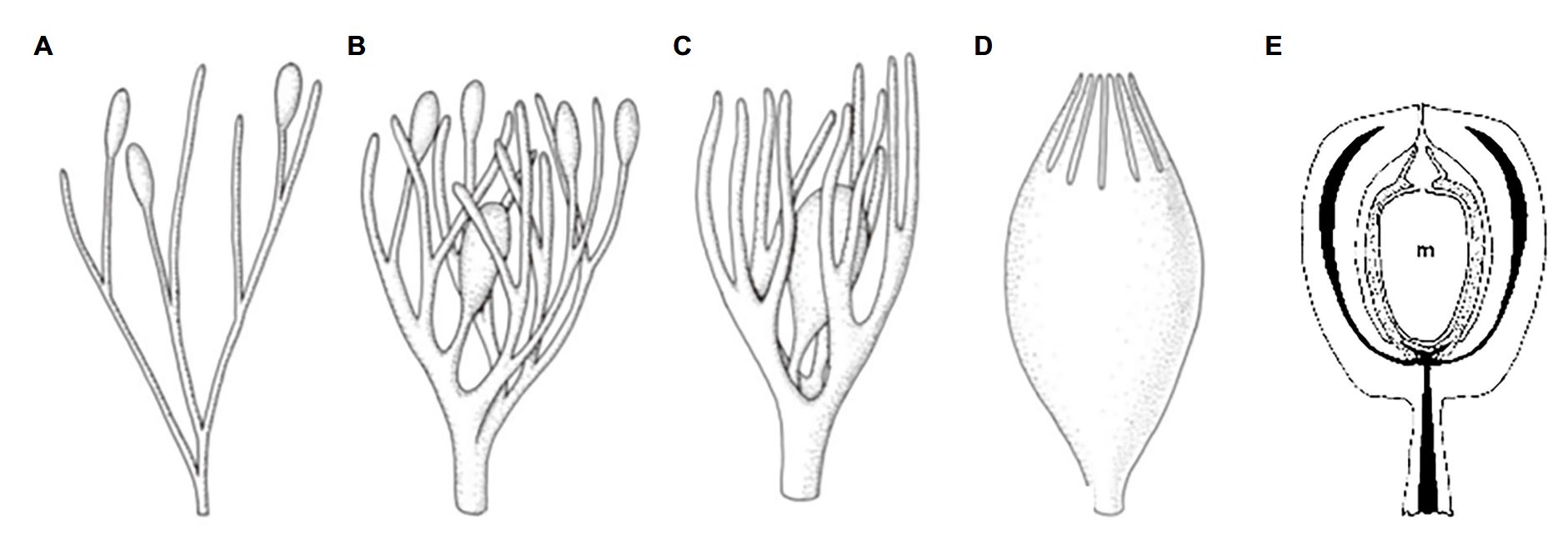
This diagram illustrates the Telome Theory of seed origin, showing how leaf-like branches evolved to fuse and enclose the central megasporangium, ultimately forming the protective integument (seed coat). (A–D illustrate the process; E shows a fossil example). Source: Bai, S.-N., Rao, G.-Y., & Yang, J. (2022). Origins of the seed: The “golden-trio hypothesis.” Frontiers in Plant Science, 13, 965000. https://doi.org/10.3389/fpls.2022.965000
The power of the plant life cycle contained in seeds becomes evident in the major role they play in sustaining life on Earth. Out of over 400,000 known plants, roughly 350,000 are seed plants, divided into two major groups: Angiosperms (flowering plants) and Gymnosperms (non-flowering plants). Their main difference is that angiosperms keep their seeds protected inside fruits, which develop from the above-mentioned modified leaves called carpels that form the ovary. Gymnosperms, however, keep their seeds uncovered or “naked”, typically on the scales of a cone. These two groups dominate the planet, forming the nutritional foundation for a significant portion of life on Earth, including humanity. Our diet relies primarily on their fruits and seeds, including staples like rice, corn, beans, and thousands of other plant species. Therefore, the future of plants is intimately connected to the future of humanity and life on Earth.
Plant species, like most living organisms, must colonize new places to expand and maintain their populations. But how does an organism that cannot move on its own manage to travel across landscapes? The answer is seed dispersal—the essential ecological mechanism that moves seeds away from their parent plants. This process relies on different dispersal agents that carry seeds far and wide, including wind (anemochory), water (hydrochory), gravity (barochory), animal species (zoochory), and other rare, fascinating mechanisms like explosive fruits (ballochory) that launch their seeds several meters away. Some hypotheses state that these mechanisms are the result of coevolution, by which plants reward animals with edible fruits or nutritious seeds in exchange for dispersal.
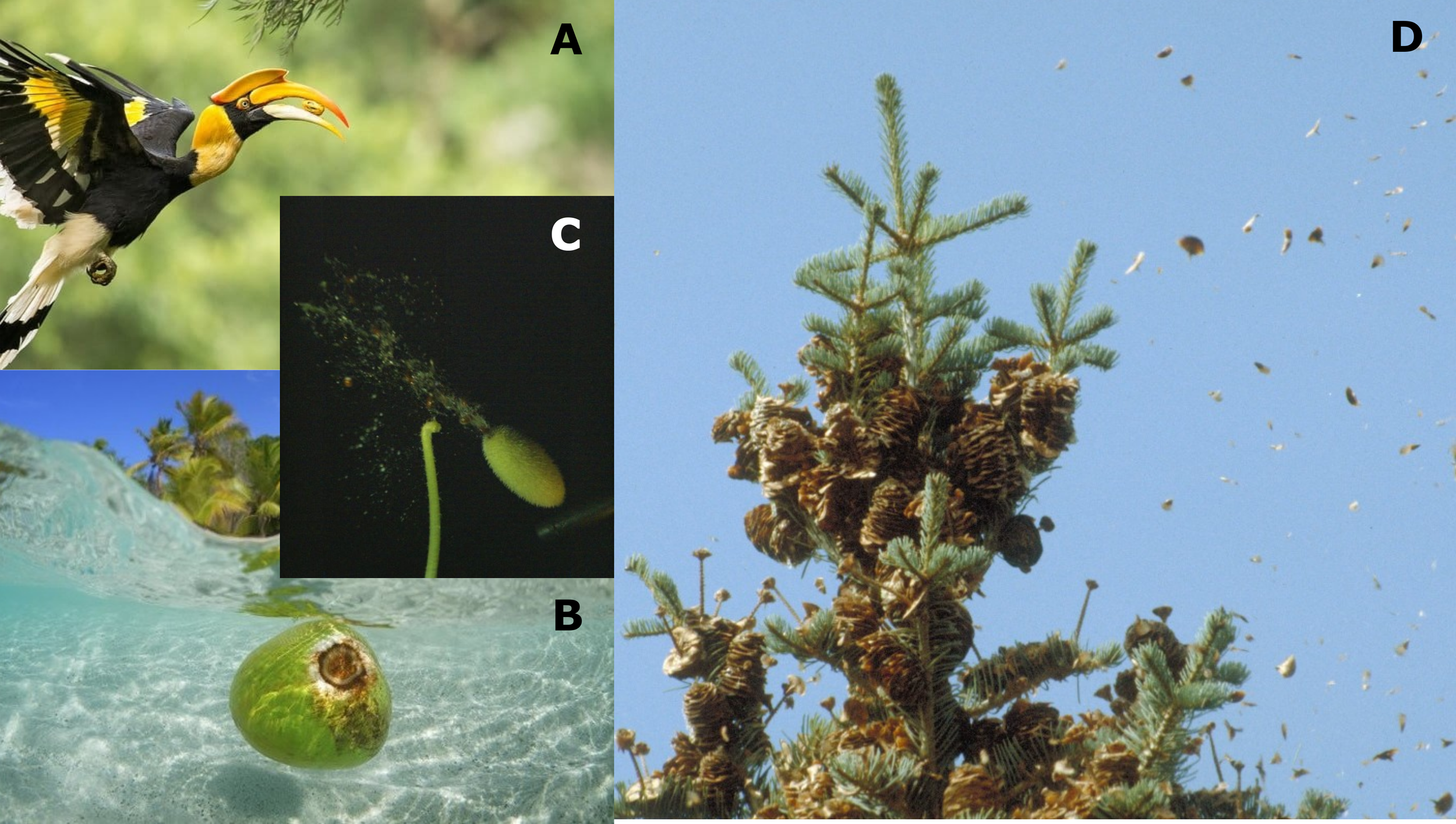
The major modes of seed dispersal are (A) animal, (B) water, (C) explosive, and (D) wind. Images of animal, water, and wind dispersal were taken from Wikimedia; the image of explosive dispersal is from Box, F., Moulton, D. E., Vella, D., Bhagotra, Y., Lowe, T., Goriely, A., & Thorogood, C. J. (2024). Uncovering the mechanical secrets of the squirting cucumber. Proceedings of the National Academy of Sciences, 121(50), e2410420121. https://doi.org/10.1073/pnas.2410420121.
Seed dispersal is crucial for plants to sustain their populations. This process allows plants to find new places with the right conditions to germinate, avoid competition, and escape from natural enemies (predators, pests, or diseases). Furthermore, it allows forests and other plant ecosystems to recover after disturbances. However, climate change and other anthropogenic disturbances have deeply affected these dispersal mechanisms, often disrupting the co-evolutionary relationship between plants and their animal dispersers through local extinctions or population decline. This has drastically changed ecosystem dynamics, leading to the dominance of species with different dispersal methods and creating cascading effects. These impacts span from the persistence of ecosystems and their species, impacting the entire web of life on Earth, to serious challenges for global human food security.
The critical question is how to prevent the collapse of this vital seed dispersal network. When it comes to science, there are still several mysterious aspects of seed dispersal that need to be urgently addressed in the face of global change. We need to understand what fundamentally drives the relationship between dispersal agents and dispersed plants. But we also need to understand what the dynamics of plants of different dispersal syndromes are, the specific environmental conditions they require to thrive, how they interact with other species, and how the dispersal behaves under different ecological conditions—including how far a seed can travel, and, most importantly, how climate change will affect all these aspects of dispersal. However, the nature conservation action, at local and large scales, will help us to gain time to be able to understand this before the change becomes irreversible. Although we know much about seed dispersal, we do not yet fully appreciate that the seed—that tiny, self-contained package originating from a series of modified leaves, which both initiates and closes the plant life cycle—is a key aspect of ecosystem health and human persistence. Therefore, our apparently simple, everyday food harbors a powerful evolutionary and ecological history that supports life on Earth, and needs to be understood to protect the wonderful, overlooked biodiversity that surrounds us.
